
Fitting Guide
Getting the fit right is the key to keeping your horse comfortable and protected. Follow the guides below for each component. If you need help at any point, don't hesitate to contact Yvette.
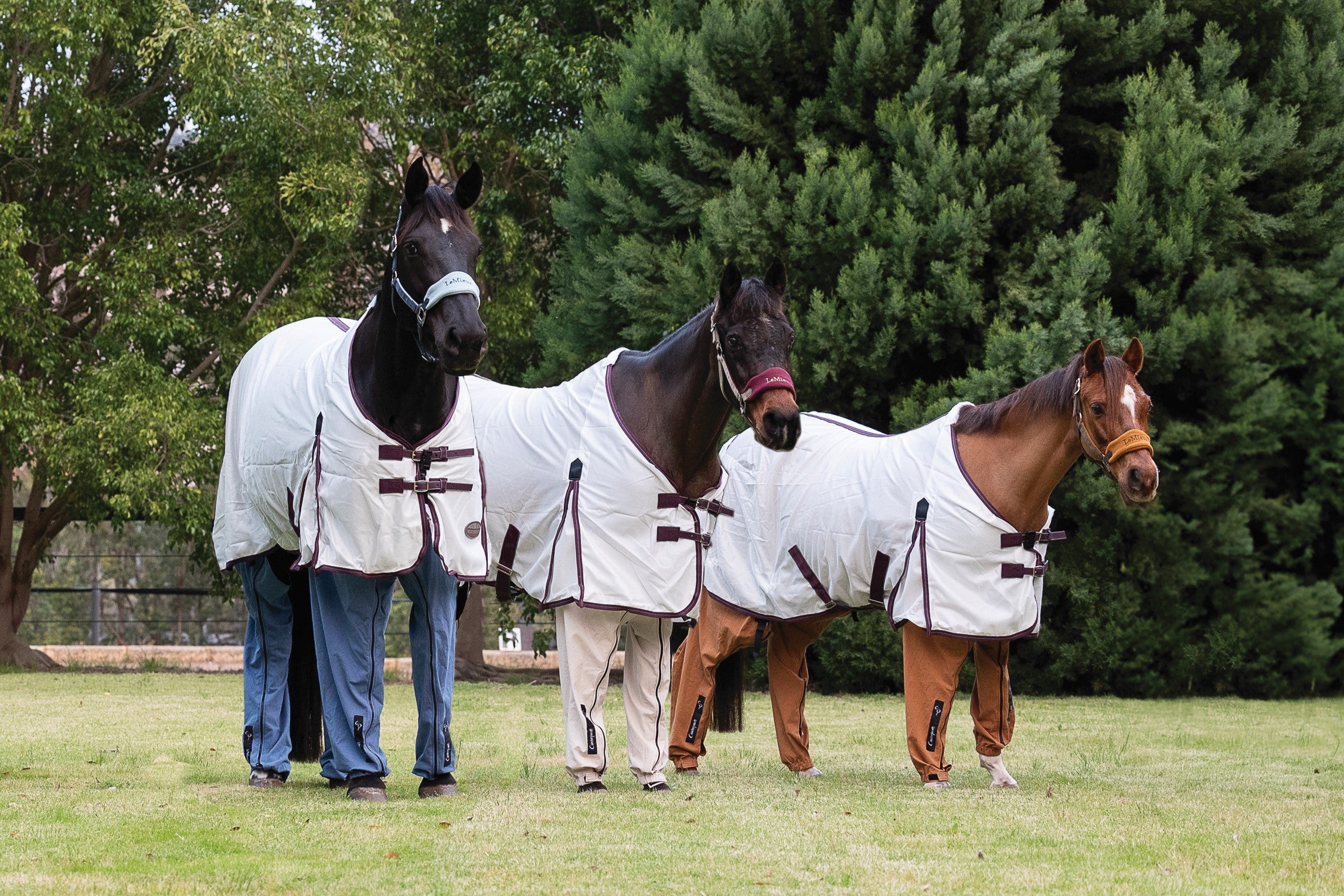
Getting the fit right is the key to keeping your horse comfortable and protected. Follow the guides below for each component. If you need help at any point, don't hesitate to contact Yvette.
Before You Start - Check Your Rug!
Canterpants® have been designed based on certain assumptions about your rug. Before fitting, please ensure your rug meets our requirements has the necessary attachments (standard chest strap and leg strap D-Rings) or that you have the necessary attachmnents fitted to your rug and/or chest bib.
If you're unsure, check our Rug Requirements, or contact Yvette
The Belly Band is required as the rear connection point for front Canterpants. Alternatively, D-rings or similar can be sewn into your horse's rug or chest bib.
To fit the Belly Band, simply pass the band over your horse's back and buckle at the near side elbow.
Adjust the elastic strap. It should be gently hugging your horse - not tight.
Check that the D-Rings are sitting in approx the same position on each side of your horse, before putting on your horse's rug
We recommend fitting Canterpants® under the rug.
Video approx 20sec
The Chest Buckle provides the connection point for the front Canterpants. Alternatively, a D-ring or similar can be sewn into your horse's rug or chest bib.
The Chest Buckle is simply clipped over the rug's chest strap as the anchor point for the front buckle of the front Canterpants.
Or, pass the rug's chest strap through the closed chest buckle.
Video approx 20sec
Front pants are straighter, and Hind pants have hock shaping in them.
Front Canterpants are simply clipped onto the front and rear connection points (Chest Buckle and Belly Band respectively), adjusted for size and secured by zip and velcro.
To tell left from right - Hold the pant leg with the logo facing you (outer leg) and if the zip is on the left, it is a left leg; and vice-versa
With the zip closed, clip the left front leg on to the D-ring at the chest and belly and adjust the straps so that the bottom of the pant leg sits on or just above the ground. Then close the zip and secure the velcro at the pastern (allowing two fingers to easily fit under hem).
Repeat this for the right front leg, then take your horse for a short walk to check the fit. The pant leg should lose the bagginess, but not ride up over the fetlock.
Adjust the straps if necessary. Strap adjustment may need to be repeated after wearing as the pants and belly band settle into place with the horse's movement.
Note: If you are not using the Belly Band and Chest Buckle you will need to provide alternative connection points at the chest and behind the elbows.
Video approx 50sec
Hind pants have hock shaping in them, whereas front pants are straighter.
Hind Canterpants are simply clipped onto the leg strap D-rings at the stifle and rump (or alternatives)
To tell left from right - Hold the pant leg with the logo facing you (outer leg) and if the zip is on the left, it is a left leg; and vice-versa
With the zip closed, clip the left hind pant leg onto your rug's leg strap D-rings so that the bottom of the pant leg sits on or just above the ground. Then close the zip and secure the velcro at the pastern (allowing two fingers to easily fit under hem).
Repeat this for the right hind leg, then take your horse for a short walk to check the fit. The pant leg should lose the bagginess, but not ride up over the fetlock.
Adjust the straps if necessary. Strap adjustment may need to be repeated after wearing as the pants rug will settle into place with the horse's movement.
It is common for a horse to walk with a high step when first trying hind Canterpants.
Video approx 40sec
Pull-On Canterpants need to be pulled on over the horse's hoof and then clipped onto front and rear connection points (Chest Buckle and Belly Band for front pants and leg strap D-rings for hind pants).
To tell left from right - Hold the pant leg with the logo facing you (outer leg). The higher strap should be facing the front, and the label on the strap assembly will confirm the leg position.
Before fitting the pant leg clip the left front leg on to the D-ring at the chest and belly and adjust the straps so that the bottom of the pant leg sits on or just above the ground. Then unclip the pant leg before pulling the pant leg over the horse's hoof and then pulling them up and clipping them on.
Repeat this for the right front leg, then take your horse for a short walk to check the fit. The pant leg should lose the bagginess, but not ride up over the fetlock.
Adjust the straps if necessary. Strap adjustment may need to be repeated after wearing as the pants and belly band settle into place with the horse's movement.
Repeat this process for the hind pants, clipping to the leg strap D-Rings.
Video approx 25sec
The pant leg should blouse gently at the fetlock - a little fabric pooling is normal and intentional, allowing for movement. Be careful not to have excess fabric posing a trip hazard.
Things to try:
If the pant leg is riding up above the fetlock, it not only prevents full leg coverage, but may also restrict movement.
Things to try:
Refer to our rug requirements guide
If the front of the pant leg is sitting loosely at the chest, it is often due to a low chest strap on the rug.
Things to try:
The belly band should be gently hugging your horse - not tight.
If you've worked through the guide and tips above and still can't get the perfect fit, don't hesitate to reach out. Yvette is happy to help.